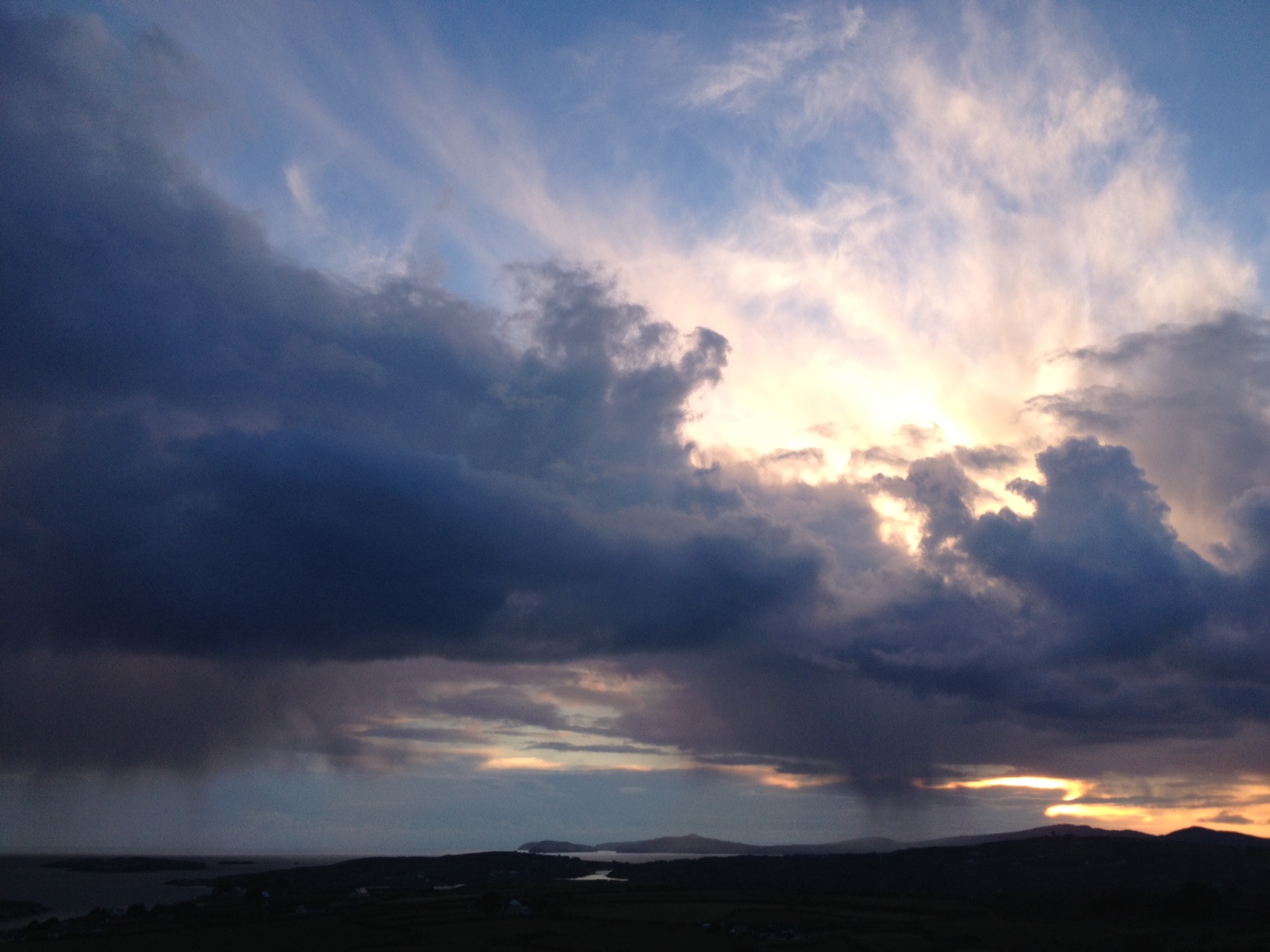
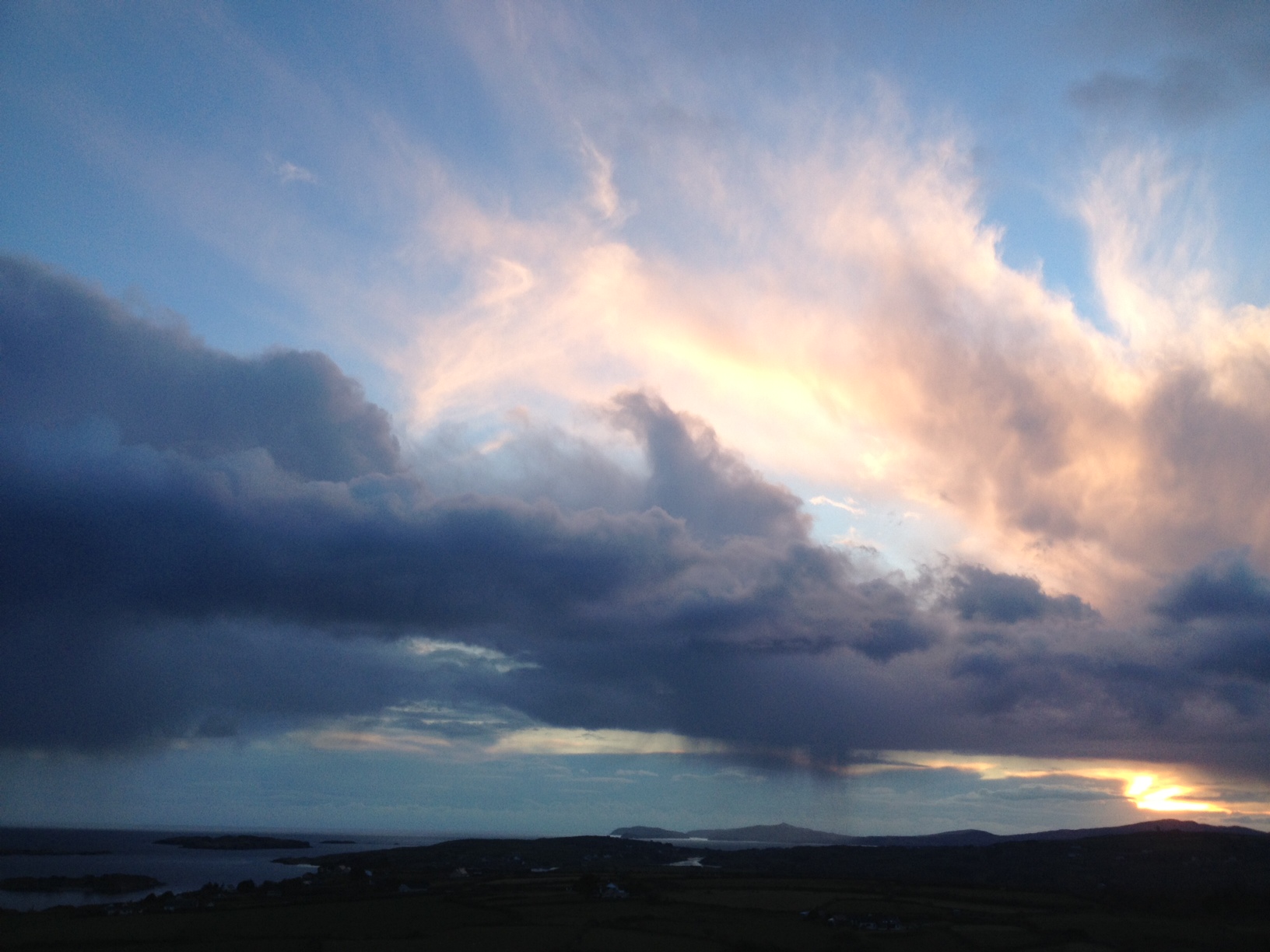
Amazing skies

stunning West Cork landscape

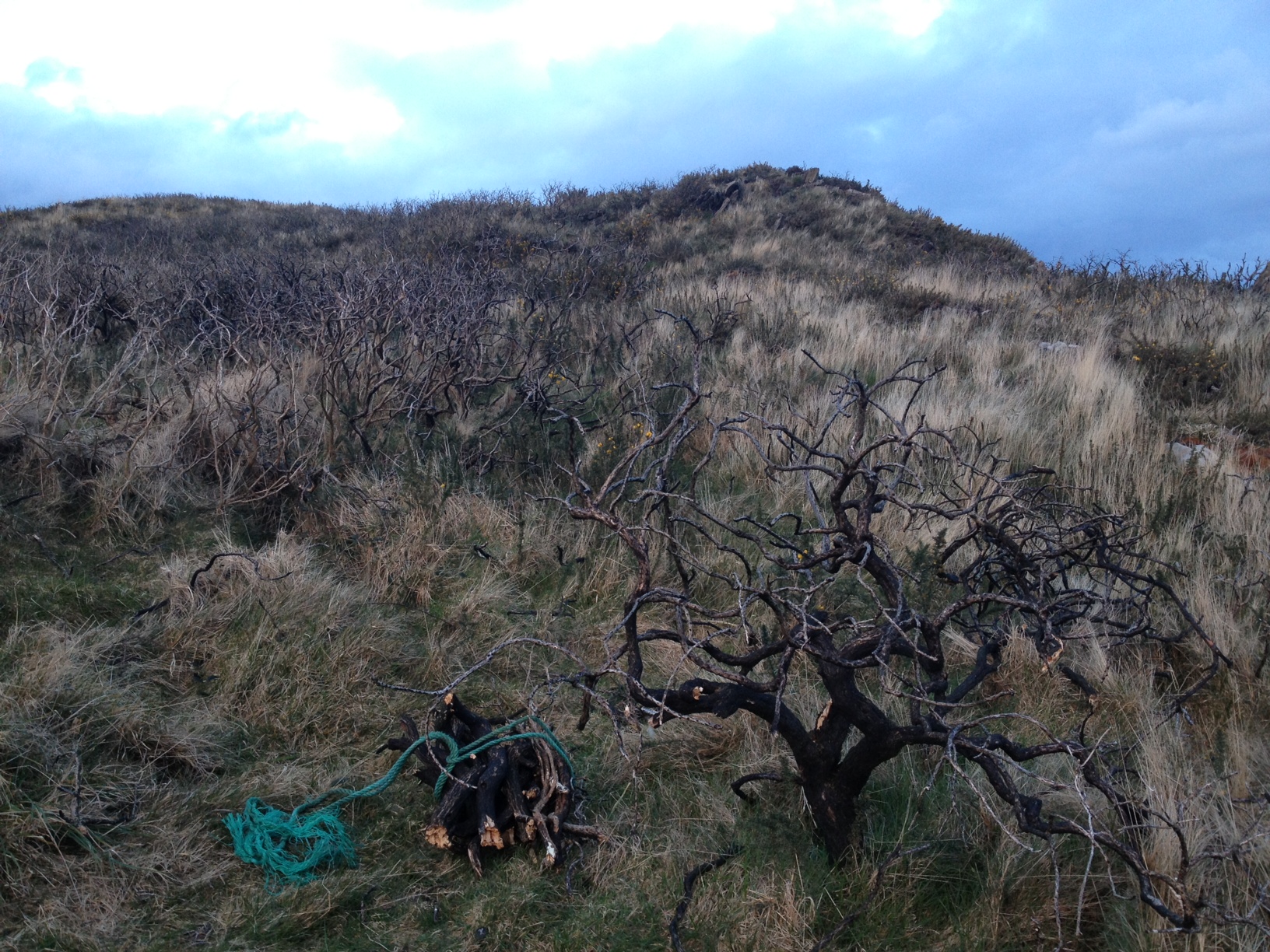
Collecting gorse to spark up the fire

This is a brief post today – and more about living rurally than writing. You’ll see why in a minute. It might even take your mind off this freak cold weather for a moment.

Living rurally, we’re lucky to have the opportunity to make our lives as self sufficient as possible. The other day, myself and my husband were out collecting gorse for kindling. It was a lovely bright and warm day when we set out, but as you probably know, Ireland is prone to some weird weather habits.

Firstly, we were showered with hail, even though there was an incredibly bright sun. We could see dense clouds in the distance, and Cape Clear was getting a battering, but there wasn’t a hint of cloud near us.

Incredible West Cork sunset

Such elegant shapes…

Distracted for a moment, we watched the dark skies sweep across Atlantic, before carrying our bundles home. However, we couldn’t resist returning as night fell…

Just look at these amazing cloud formations and colours! The perfect example of how your environment can inspire your work or your motivation to work. I couldn’t resist sharing. There are no filters or camera tricks involved, I promise…

Sunset, West Cork

…and dramatic colour.

West Cork, sunsets

You can see the hail cloud clearly here

gorgeous skies, west cork

Isn’t the orange stunning?

Watching the sky change was an incredible experience – something we do frequently, but probably not frequently enough. After all, thanks to these skies, these views, this fresh air, I manage to write with a clear mind and happy heart. What more could I ask for?

What encourages you to keep writing?

Creative jealousy

Two bizarre statements I heard this week from aspiring writers:

1) I never read that author because I’m too jealous of his writing.
2) I don’t read contemporary literature because I don’t want it to spoil my own writing

I can hear the resounding intake of breath from here, so let me deal with each of these separately and then I’ll let you say your piece.

I never read that author because I’m too jealous of his writing.

green eyes

Keep the green-eyed monster away

What sense does that make? Surely you read the authors you enjoy so that you can learn from them? Avoiding your favourite writers won’t make your own writing process any easier, and you lose out on some valuable learning. Keep up to date with the writers that you would like to emulate. It’s not copying, it’s infusing good technique, style and quality prose into your own writing. It’s called self improvement. Try it!

I don’t read contemporary literature because I don’t want it to spoil my own writing.

Rather than spoil your writing, reading your contemporaries should inform your work. How can you learn anything about what people like to read, the publishing industry and good technique if you avoid reading current literature? Reading is an important part of any writer’s life and is one of the best forms of education. Why miss out? Also consider this: if you don’t enjoy reading contemporary literature, why are you trying to write it?

In my mind, both of the above statements are the result of creative jealousy – and like any form of jealousy, this leads to destructive and detrimental situations for the person involved. Without knowledge, learning and the motivation to evolve, any aspiring writer will remain exactly that. In short, unpublished.

My advice to any other aspiring writers who want a successful writing career is to make use of the resources around you, including contemporary literature. Don’t succumb to creative jealousy. Read like a writer, soak up the language and technique and see where it leads your own writing journey.

What are you reading at the moment and how does it influence you as a writer?

You’re not alone

You’ll find that writers are a very supportive bunch on the whole. They understand the pros and cons, highs and lows (admit it, there are lows) that writing involves and they are always willing to help – whether it’s reading through a piece you’re ready to submit, cheering you on when you’ve achieved something you’re proud of, giving tips on writing technique, or giving you a nod at the right times when you’re having doubts.

This can be in person, via email, twitter or Facebook, a text message or a phone call. You might find a revelation in an article, book, blog post, TV documentary or piece of journalism. The source isn’t really important. The point is, you are not alone. Help and support is out there. 

Usually, writers offer their support without question or judgement – just ask and see! – but sometimes, useful advice is given at just the right moment, by mistake. Such an incident inspires this week’s blog post, thanks to Susan Lanigan.

Shrimp pot in the Atlantic

Don’t let fear or doubt pull you in the wrong direction

Last week, Susan posted On Luck and Writing. She opened the post with – “Yesterday, I had a moment of uncertainty about my writing. The usual questioning and fear and stuff. To distract myself I picked up a book that did not belong to me and which I would never normally read…”

This resonated in two ways. Firstly, my mindset at the end of last week matched Susan’s exactly. Secondly, I too needed distraction, and On Luck and Writing proved the perfect tonic.

Usually, I’m all about staying focused but the more I write, the more I value those snippets of free time that you can salvage for research, reading about other writers and winding down. I’m still not great at it, but I’m improving.

Last week, my mindset was simply a product of over work and then stressing about not working enough which in turn generated negative feelings towards my output. Rather than remembering to enjoy the process, without too much inner reflection and criticism, I got caught up in over-analysing results and steaming towards unnecessarily ambitious, self-imposed deadlines.

I know, foolish. But what can I say? I’m only human. I think we can all fall into that trap on occasion. The important thing is that we realise it and rein ourselves in.

Like Susan’s post highlighted, we have a tendency to over-think things and allows ourselves to contemplate failure before we’ve even given things a fair try, flitting from one thing to another trying to find ‘the right answer’ instead of trusting our instincts and continuing on, unshackled.

Personally, I enjoy working on different projects – e.g. poetry, haiku, themed submissions, different word counts for stories – to hone my skills and keep things interesting. But when it comes to my novels, I have to trust my instinct and write what I want to write, what I can write well. It’s usually pretty easy, but sometimes, I need a post like Susan’s to remind me that that’s exactly what I’m doing and it’s the right choice to make.

Many people ask editors and publishers – ‘what are you looking for?’ – as though there is a magic ingredient that will ensure your book/s will be published. The truth is, even though publishers have gaps to fill, there is no such magic ingredient. What they want is a damn good story.

Sometimes your book will be rejected because it’s got a way to go, and it’s an almost damn good story with potential. In this case, listen to the advice you’re given, treasure it and use it to feed into your next draft. Sometimes, your book will be well written but the story isn’t quite damn good enough. Again, listen and act accordingly.

On other occasions, you’ve got a damn good story and it’s really well written, but it doesn’t fit a publisher’s list right now. Or any publisher’s list. That doesn’t mean that it never will, but neither does it mean – ‘quick, write a crime novel because they’re selling well’, or ‘switch to Young Adult, there’s a great market for it’.

Stay calm and carry on writing what you write in the way that you write it. All the while, you will be honing your writing skills, stimulating your imagination and writing more books. If you really want to be a writer, write. No matter what your inner critic says. You cannot let the inner critic hold you back or send you in the wrong direction.

In the words of Susan, “Hunt for what you want. Don’t be a prey animal. Be a predator.”

Great advice.

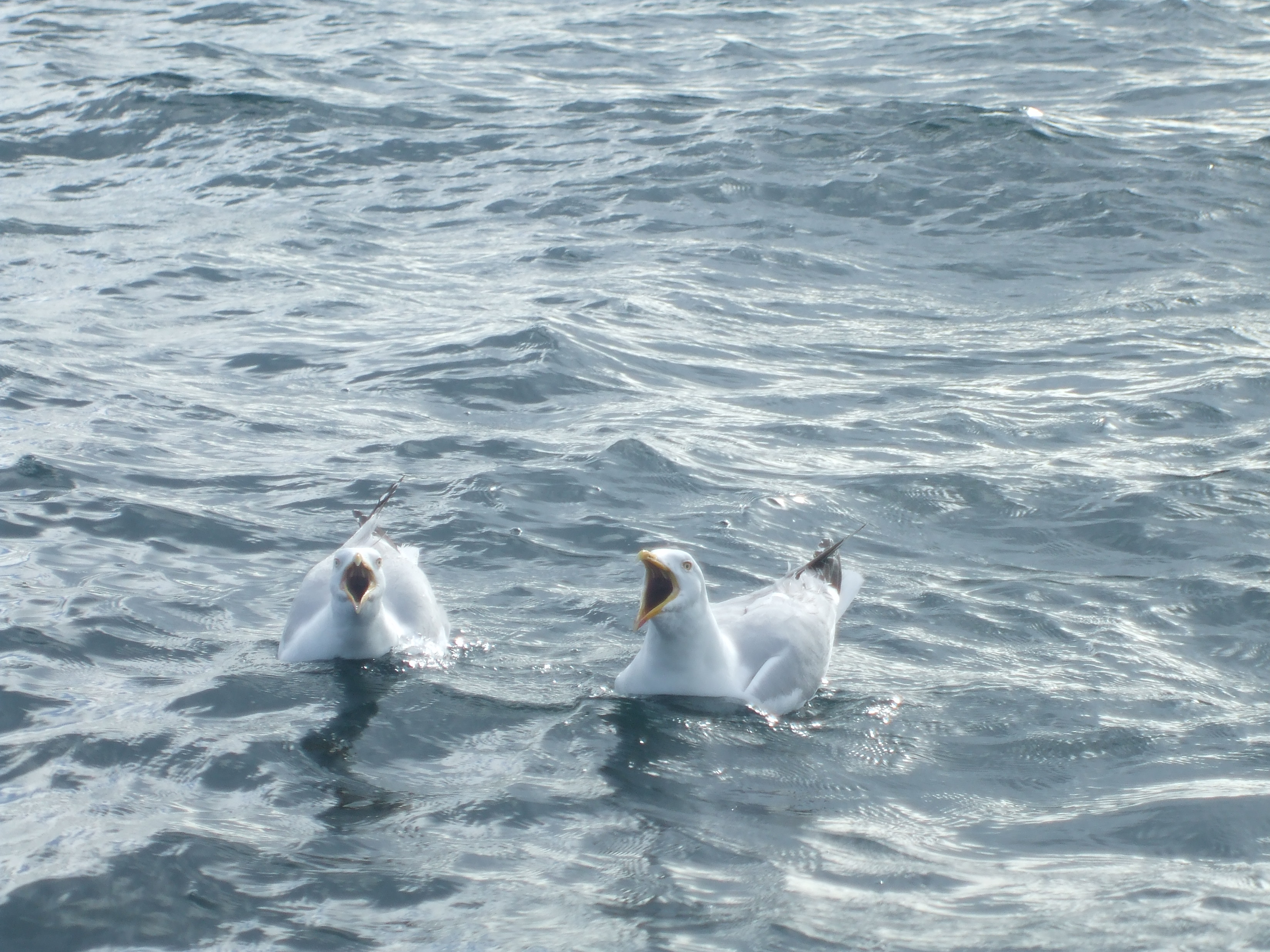
Squawking seagulls on the Atlantic

Silence the inner critic!

As you go into a new week, put any silent doubts, fears, anxieties or uncertainty about your writing behind you. You are a writer. So write. It’s that simple. Who cares if you have to wait longer for that elusive publishing deal or literary journal to accept your work? Stay on track, be dedicated to your craft and it will come.

I’d like to end with a huge thanks to Susan for being there at the right time, giving much-needed advice, without even realising.

Who has inspired/helped you over the last week? Share it with us – you never know who might need to be listening.

Make the most of your writing time

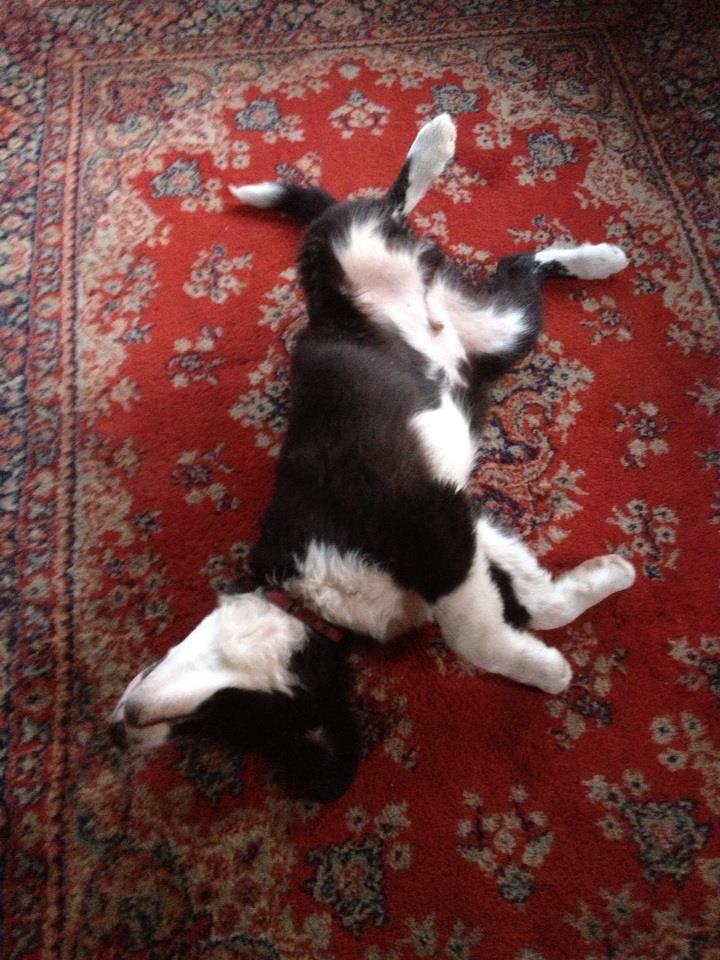
funny sleepy puppy

Franklyn has mastered the art of maximising his time

I was going to call this post ‘make your writing time last longer’ but I reconsidered, deciding that it was probably an outlandish claim seeing as most people juggle jobs, families, and generally hectic lives, as well as their writing.

Not everyone can stretch their time to incorporate more focused writing, but we can all make the most of the time we have available to generate ideas, edit current work and generally further our projects. (This applies to non writers too – as you read on, replace the writing references with whatever hobby/work tasks are relevant to you.)

Here are a few tactics that I rely on to get the most out of my day and maximise its potential.

Exercise first thing. I find this stimulates the body and mind and unclutters your brain. How long does it honestly take you to get going in a morning? Why not use that time to get the oxygen flowing round your body and benefit from the feel-good factor of having a great start to the day?

Many people choose to exercise with a friend because they find it motivating, but I recommend going alone if you can. You’l find your mind fresh and alert, rather than bogged down with gossip/problems – and it’s much easier to get started right away on your projects when you’re done exercising.

Choose wisely. Some writers leave their work with a sentence unfinished, so they’re itching to get started the next day. Personally, I like tasks to be ‘completed’ (read – finished to the best of my ability in that session) before stopping. If you know you only have fifteen minutes to write, and that that’s how long it takes you to get into your character’s mind to work on your current chapter, for instance, don’t set yourself up for failure. You’ll only feel irritated and short-changed when you have to stop. Choose something else that will move you forward.

For instance, is there a character’s name that doesn’t sit right? Research alternatives and mindmap ideas. Is your title not quite working? Play with that. How about redrafting a paragraph of a short story that’s been niggling at you? Maybe there’s a themed submission you’ve got your eye on but haven’t come up with anything yet? It’s time to play with ideas! As writers, the task we choose is vital to our sense of achievement.

sleep kittens cuddling up

As you can see, my cats also follow my advice.

Switch tasks. If you swap between tasks, you can honestly write for longer. It’s a great way of maximising your time. I find that by the time I’ve edited two chapters, my mind is straying from the task in hand and any subsequent chapter editing isn’t as focused. In other words, I need to walk away until the next day. However, I don’t need to walk away fro writing completely.

If I switch to a short story, or a piece of flash fiction, or even my next blog post, I work completely refreshed. I find, however, that trying to plan too rigidly can get stressful because you feel like you can never do enough. Write a list of the writing goals you want to achieve that week, with your main WIP prioritised. Once you’ve achieved your main goal, work through the secondary list one by one. You’ll be amazed how much you can accomplish.

Notebooks & other devices. All writers talk about the ingenious notebook – that magical place where we can jot down overheard snippets of conversation, plot ideas, observations and interesting facts that may be useful later. But they’re not that ingenious if they’re sat on the desk at home, unopened. Get used to carrying your notebooks around – make it a habit, like picking up your keys or driving glasses.

If you prefer technology, or a multi-sensory approach, use an app on your phone like Evernote to record ideas and inspiration. I love Evernote because you can take snaps, record your thoughts via audio and make notes – all in the same spot. And if you sync them online, you can access them at any time from any computer. Genius, hey? There are various diary and note taking apps available – try some free downloads until you find one that you enjoy using. Then you have yet another handy tool for collecting ideas.

Create time. Ask anyone about their day, and they’re busy. Almost too busy to tell you about their day. You don’t get many people saying – well, I read a paper, walked the dog, then sat staring out of the window, enjoying the view for a few hours. We’re all busy all of the time, but look at how you’re spending your day and ask yourself – am I spending my time wisely?

People with incredible lives make them incredible. They make choices that give themselves more time to do the things they want to do. Are there things you could do smarter? For instance, could you combine tasks, such as walking the dog to buy your groceries? Do you really need to sit chatting during your lunch break, or could you fit in an extra half hour of writing? Even twice a week? Is it really necessary to spend that much time on Twitter? Which leads us perfectly to…

Internet off. Not forever, but while you’re writing. When you’re writing, that should be your sole focus. Otherwise, you’re in your world, not your character’s – and how is that going to be believable to your reader?

Then there’s the distraction of checking emails, chatting about your writing on twitter (otherwise known as procrastinating), sticking up some inspirational pictures on Pinterest – ooh, and then I wonder how THAT writer’s getting on over on Facebook. We’ve all done it. But there’s nothing that can’t wait until you’ve achieved that day’s goals. So while we’re at it…

franklyn puppy with toy collection

Internet, phones, TV off. No distraction here! I’m 100% focused.

Phones off. Voicemail is the answer. We’re used to being completely contactable 100% of the time, but is it necessary? When police are patrolling the streets, they can’t use their mobiles – and their nearest and dearest wouldn’t even consider trying to call them while on duty. Likewise for librarians, schoolteachers, shop assistants and anyone else when they’re working. And so be it for writers. Only you have to make it clear – and stick by it.

No TV. I know this isn’t ideal for everyone but if you don’t switch the TV on, you’re not distracted. If you don’t have a TV, there’s no ‘switching it on for background noise’ then ‘accidentally watching’. When people go on holiday, they’re amazed at how much they fit in. Often, it’s because they’re not sat watching TV for a section of their day.

That’s not to say TV is a bad thing, but if you want to maximise your time it’s a no go area – at least while you’re writing. A less drastic alternative (and a nicer compromise) is to set a writing task that you have to finish before you switch the TV on. There, that wasn’t so bad, was it?

Wait. This is the one that many find hardest of all – especially in the early stages of a writing career – but waiting is actually beneficial. Letting your writing sit for a while before redrafting works wonders. Flaws are easier to spot, tongue-tied sentences stick out and if the idea hadn’t quite blossomed enough, the gaps are easier to identify. In short, the quality of work you produce is often much higher than if you tried to redraft it day after day for a week. If you don’t already wait, try it and see.

Now I don’t claim to be an expert on these matters, but these things work for me and I hope they work for you too. If you have any other tips on making writing time more effective, please let me know! I’m always looking for ways to keep the day productive, stress-free and enjoyable – while making the most of my writing time – so all suggestions are welcome!

How will you make the most of your writing time today?

Anyone need a writing prompt?

Australia, Blue Mountains

I remember sun. I think I quite liked it!

I’m back! I’ve reached the finish line and my book is now with my agent – phew! I’ve also managed to squeeze in a few writing competitions along the way.

Luckily, just like the lovely Hazel Gaynor, I’m brimming with new ideas. But I realise that isn’t always the case…Which is partly why I write the Wordspark blog for writing.ie

If you haven’t yet heard of writing.ie, it’s a wonderful site set up by Vanessa O’Loughlin for writers at all stages of their career. Although Ireland-based, it’s suitable for writers anywhere in the world. If you haven’t already, take a peek. There’s so much info on there from some of the world’s top best-selling authors, it’s an invaluable resource.

But back to ideas for your writing…

The idea behind Wordspark is to get creativity flowing. The prompts can be used to fire up the imagination as a pre-writing/editing exercise or to spark off a piece that can be sculpted into a competition or journal submission further down the line.

It’s a little extra help, when needed.

Here are a few of the #wordsparks already posted – take your pick and join in!

Description – ten words describing the sea

Postcard Prompts x3 – Trains, Art and Balloon Sellers

Rhyming Couplet – using a photo as inspiration.

There’ll be plenty more coming. If you find them useful, stay tuned!

The Next Big Thing – Tag! You’re it!

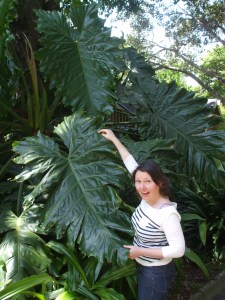
Giant Australian leaf

It’s all about the right conditions

I’ve watched this game of writer’s tag with interest, enjoying its supportive spirit and collaborative camaraderie. I’ve really enjoyed learning about other writers – some familiar, some not so familiar – and following the meandering path to a host of new reads. However, I didn’t expect to be included in the game. I was happy to remain a spectator, cheerleading from the sidelines, but I was delighted when Bernie McGill hollered over the vegetable patch and asked me to contribute.

Bernie McGill (@BernieMcGill) is a short story writer (a collection is forthcoming in 2013 from Whittrick Press) and author of The Butterfly Cabinet. She was the winner in 2008 of the Zoetrope:All-Story Contest in the US and her short fiction has been shortlisted for numerous prizes including the Bridport, the Fish, the Asham, the Michael McLaverty and the Seán O’Faóláin short story awards.

I’ve just delivered my next novel to my agent Sallyanne Sweeney, but, like many writers, I’m a bit superstitious about revealing too much about that particular project until it’s found a home. So I’m going to talk about my experimental short fiction sideline, which may or may not be a success. All will be revealed…

1) What is the working title of your next book?

The short fiction I’m currently writing is intended for competition and journal submissions, but I’m experimenting with interlinking plot and characters with the intention of turning them into a novel. At the moment, there are two working titles – The Book of Us (taken from a poem recently published in Southword journal) and Dinosaur Stones. If anyone has an opinion on which they’d be more likely to pick up and read, I’d love to hear why!

2) Where did the idea come from for the book?

I believe that variety is important when you’re writing. Although I mainly write novels for a younger audience, I like to challenge myself with adult short stories and flash fiction at the same time. Engaging in such a different discipline helps keep the ideas flowing and, more importantly, allows me to play.

The idea of constructing a novel from linked short stories – with each chapter a stand alone tale, written from a different character’s viewpoint, but ultimately inextricable from the bigger picture – has always appealed to me. I love patterns. I love puzzles. And I enjoy the extra dimension these elements give to my writing.

This is something completely new for me and I’m treating it like a scientific experiment. I usually write books I know I can definitely write, and so this is a self-induced challenge. It’s a sideline; the chance to fail spectacularly. And something about that really excites me.

3) What genre does your book fall under?

At the moment, short fiction – it’s a mix of short stories up to 3000 words and flash fiction, as short as 500 words. But if the idea of turning it into a novel works, then I’d say literary fiction.

4) What actors would you choose to play the part of your characters in a movie rendition?

One of my stories would really benefit from Jack Nicholson playing the main character – a jaded, indecisive widower with a dark future ahead of him. And in another, I’d love Paul Dano to play the disaffected, displaced youth – he conveys anger and torment so convincingly.

5) What is the one-sentence synopsis of your book?

Always a difficult one but something like this perhaps…”A darkly humourous yet revealing tale examining the intricacies, depth and contradictions of human relationships.” Maybe that sounds more like a review?

6) Will your book be self-published or represented by an agency?

My aim is to submit the stories separately to competitions and journals, with a view to presenting the evolved, novel version to a publisher in the future. If the novel idea does not work – as I say, this is completely experimental and may not work at all – then I might present the stories as a collection. But as we all know, the short story does not receive quite as much attention as it deserves. Thank goodness for entities such as the Cork International Short Story Festival and The Short Review.

7) How long did it take you to write the first draft of the manuscript?

The first draft is a work in progress because it’s a sideline, written in tandem with my main projects. I’m also taking a completely different approach using short stories as the basis. Usually I write a first draft of a novel in one month – more of a non-draft really – and that provides me with the lump of clay I need to mold.

In this instance, I expect the collection of stories to build up over the next year  and then the shaping of the novel to take another year. I find short stories extremely difficult to write. Novels give you more room to explain and examine – short stories are a completely different art form. I need to let them sit for longer and they take much more time to feel ‘complete’. Having this as a side project makes the timeline possible without it being frustrating.
it doesn't get much better than this

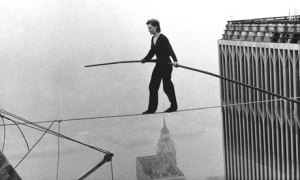
Let the great world spin… Philippe Petit walks between the World Trade Centre’s Twin Towers, 7 August 1974. Photograph: Alan Welner/AP

8) What other books would you compare this story to within your genre?

If the novel idea works, think Colum McCann’s Let the Great World Spin. That’s a great example of what I’d like to achieve. In terms of short stories, I’m still not sure I’ve mastered the art, so I’d rather name some amazing short story writers that I love and that I hope will somehow influence my work – Kevin Barry, Alexander McCleod, Haruki Murakami, Angela Carter, Raymond Carver, Deborah Willis, Flann O’Brien, Roald Dahl.
 
9) Who or what inspired you to write this book?

The desire to play with a variety of characters and scenarios. The need to work on something without deadlines, just for fun. The need to experiment and possibly fail. And reading Collum McGann’s Let The Great World Spin at the end of last year reminded me of a project I always wanted to do.

10) What else about the book might pique the reader’s interest?

The stories are in-depth character studies of seemingly ordinary people in a variety of seemingly ordinary situations: a kind of ‘behind closed doors’ look at how human beings function. Like any writer, I just hope that I write something that strikes a chord and brings pleasure to others. If it doesn’t work out how I expect it to, then I’ll have learned plenty along the way, and that will inevitably feed into something else…

***

Next week, on February 30th, Renée Pawlish and Hazel Larkin will be answering the same ten questions as above.

Renée Pawlish is the award-winning author of the bestselling Nephilim Genesis of Evil, the first in the Nephilim trilogy, the Reed Ferguson mystery series (This Doesn’t Happen In The Movies, Reel Estate Rip-off, The Maltese Felon, and the short story Elvis And The Sports Card Cheat), The Noah Winters YA Adventure series (The Emerald Quest), Take Five, a short story collection, and The Sallie House: Exposing the Beast Within, a nonfiction account of a haunted house investigation. Renée has been called “a promising new voice to the comic murder/mystery genre” and “a powerful storyteller”. Nephilim Genesis of Evil has been compared to Stephen King and Frank Peretti. I highly recommend her blog.

Hazel Larkin was first published when she was 12. Since then, her work has regularly appeared in a variety of magazines and newspapers. She has written on topics as varied as Asian finance and orgasms; parenting and real estate; childbirth and transcontinental travel. Hazel spent her 20s in Asia where she made her living writing for stage, screen and publication. She was the co-editor of The Big Book of Hope (2010) and has also written a memoir, which is currently under consideration by an Irish publisher.

Susan Lanigan has short stories published in a variety of journals and newspapers, such as The Stinging Fly, Southword, The Sunday Tribune, the Irish Independent, Ellery Queen’s Mystery Magazine and Mayo News. She has been shortlisted for the Hennessy New Irish Writing Award several times, and has won highly commended awards for short stories and poetry elsewhere. She is currently shortlisted for the Irish Writers’ Centre Novel Fair.
Gone, but not forgotten…

collie pup rescue dog

Our new addition – Franklyn

I’m referring to you. Yes you.

January is a jam-packed month as I complete the final edits for my next book – a YA tale about the effects of alcoholism. As a result, I’m taking a short sabbatical from writing posts for the Green Fingered Writer blog.

It’s not because of New Year’s resolutions – we all know they get broken as quickly as they’re made. Like a car or electrical appliance, their value disintegrates the moment they’re bought.

The reason behind my retreat is that I need to free up as much time as possible. To edit the book, gather final bits of research and to get some space from my manuscript.

I need to breathe.

I’ve realized that one of my many failings is that I don’t let myself wind down enough. I live in a beautiful place and lead a very fulfilling life – but my time is so rigid, I sometimes forget to have fun along the way.

Only sometimes.

It’s that whole ‘get contacts before you’ve finished the book properly’ multi-tasking syndrome otherwise known as ambition. Does anyone else out there fall prey to this?

It’s when life becomes all about achieving when, in fact, the process is what’s important. I know that – I’m possibly the idea’s biggest ambassador – so why does my daily routine regularly forget?

Over the next few weeks, I’ll post some photos of the beautiful land and seascapes that surround me. Hopefully, they’ll delight or inspire you. Other than that, I’ll be in absentia until the end of January.

Sorry for the disappearing act and I hope you understand.

But know this – even though you’re out of sight, you won’t be out of mind and I look forward to catching up with you all before the month is up.

Wish me luck?

Looking back…

A long and winding road (Ravensbourne, Australia)

A long and winding road (Ravensbourne, Australia)

It’s been a great year. A rollercoaster ride. Thankfully, I love rollercoasters!

There have been quite a few shortlists, longlists and publications in 2012, but the elusive book deal is still evading me. I enjoyed some amazing opportunities such as blogging for Listowel Writers’ Week again, writing live as part of the Ciudades Parallelas ‘Station’ installation during Cork Midsummer festival and providing creative writing classes for local teens.

I finally feel as though I’ve settled into the village community and although nature was at its destructive best, we still managed to harvest a decent crop of vegetables and catch a winter’s worth of mackerel. And I can’t wait for it to all start again.

But more importantly, I’ve learned lots, like…

  • Opportunities always come – just be ready to say yes
  • Sometimes you have to say no because you’re already doing enough
  • You need to take time away from writing in your day to let ideas circulate, just as much as you need to fix ‘bum on seat’
  • Your goals are set by you and are flexible – don’t be too hard on yourself
  • Morning pages really do work – so if you want ideas to keep coming, keep them up
  • Your inner critic is both your best friend and worst enemy – get to know it well
  • To be a writer, you need to write – it’s that simple!

I hope your year felt just as rewarding. Now, time for a well-earned break (see you in the New Year)!

Do you have anything you’d like to share? What did you learn in 2012?

Try something new

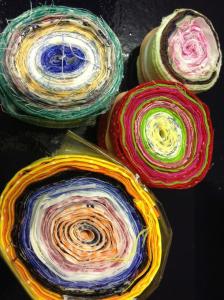
patchworkspools

Jelly rolls

I was having a chat with a friend the other day who was feeling a bit fed up. There was nothing particularly wrong, but the long nights, plummeting temperature and ghost-town effect on the village were getting to her.

It was one of those moments where you haven’t much to offer. The only thing I could come up with was – why not try something new? She looked a little taken aback, then thought for a moment and agreed…”I might just do that!”

Now that advice may sound obvious, but sometimes, we don’t see the answer staring us in the face. And trying something new isn’t always the right answer. Often, we use new experiences as an excuse to avoid the things we don’t want to do (if that sounds like you, see this article by Alison Wells on procrastinating procrastination).

But at other times, a new experience or skill is the tonic we need to keep life interesting and challenging. As a writer, this is something I definitely need.

I’ve had a mixed bag of one-off experiences. For instance, feeding sharks from a perspex cage in Australia (amazing), sky diving (getting out of the plane was the scariest bit), trapeze (not so good – I made weird girly squeals I wasn’t happy about) and walking on the bottom of the ocean wearing a lead divers helmet (surreal). Then there was running with bulls in Spain (exciting but hair-raising at times), parasailing in The Bahamas (surprisingly tranquil), swimming with dolphins in Jamaica (too cute) and stingrays in The Bahamas (less cute). One of the weirdest things I tried has to be marching with trained flamingos that kept pecking my head.

But don’t get excited; I seem to be mellowing. Living rurally certainly provides me with enough challenges of late. Yet even though everyday life is busy – think finding and chopping fuel, escapee calves, growing our own veg, flash floods, fishing, running a social media business and maintaining a strict writing routine – there’s always room for more adventure. For something new.

My latest adventure is making a patchwork quilt. I’ve always loved patchwork quilts – the detail, the weight of the fabric, the million hidden stories – so I joined a class with a neighbour in her makeshift barn studio. And guess what? It’s been an amazing experience.

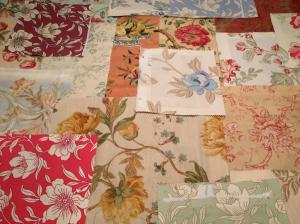
Here’s where we started, with bits of fabric and bobbins of thread…

Like a kid in a sweet shop!

Like a kid in a sweet shop!

It didn’t take long for me to select the kind of style I wanted to go with. I have to live with it after all, so it had to match my idea of style. Not to everyone’s taste, I’m sure, but I’m certain it’s going to look cracking!

Some select pieces

Some select pieces

I’ve never used a sewing machine before. I can’t drive a car and my wiggly sewing suggests there’s a link between the two. I’m still a bit scared of the sewing machine but I’m continuing nonetheless. Here’s the monster we’re using…

How do you drive this thing?

How do you drive this thing?

And after five weeks, this is where I’m at. It’s starting to come together nicely. Tonight, I’m sewing all the rows together and attaching the quilt to a backing with a blanket filling. I can’t wait.

Now, I could have put this blog post live when I’d finished the quilt, but I purposely chose not to wait. Why? Because all too often we focus on the end result and not the process. Whether it’s writing, growing vegetables or making patchwork quilts, the actual experience and learning we enter into are just as important as the finished product.

As I said, my sewing is higgledy-piggedly in places. Some of the patches aren’t quite straight. I think I’ve already stained a small bit of fabric by accidentally standing on it while organising the pattern. But none of that matters.

I’ve tried something different and have learned new skills. I got my butt out to the class, walking by torchlight along country roads in the driving rain, because the desire to play with fabric and improve on what I’d learned was greater than my desire not to. And it’s been invigorating.

What about you? What new experiences have you tried? What effect did they have?

A truly romantic true story!

Not a pirate in sight…

Today is my first wedding anniversary and although it’s not a big day for anyone else, I think the story of how it all happened is worth sharing.

In case you’re i the mood to hear a very romantic story – sometimes, I still can’t believe all the effort he went to –  here’s a re-post of how my husband proposed.  As the title suggest, complete with treasure maps and trowels…

Treasure Maps and Trowels: X Marks the Spot

It went something like this… Clamber into the punt, whizz around West Cork’s beautiful Goat Island and whistle for the goats, get up close to some wild seals, watch the gannets dive, circle Long Island and stop to catch a mackerel. Head to Long Island pier, visit one of the Islanders for tea and get given a cabbage three times the size of my head. Carry the cabbage the length of the island to Westerland strand, rescue some stranded jellyfish and barbecue the mackerel. The End.

Or so we thought…

Click here to read the full story…